
MAE Professor’s Paper Introduces Real-Time Thermal Transport Sensor to Track Battery Degradation
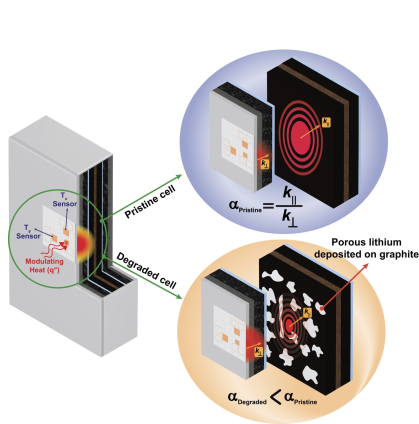
A recent paper published in Advanced Functional Materials by Rutgers Mechanical and Aerospace Engineering researchers introduces a non-invasive, surface-mounted sensor capable of real-time battery degradation tracking. Led by Professor Amin Reihani, this breakthrough measures 3D directional heat flow to assess a battery’s internal state of health directly in the field. By bypassing traditional electrical metrics, the sensor can evaluate an individual cell's health continuously without ever requiring it to be isolated or separated from its current battery pack.

The Innovation
- Direct Microstructural Sensing: Conventional methods like Electrochemical Impedance Spectroscopy (EIS) require long data acquisition and cell isolation. In contrast, this thin-film sensor continuously measures the cell's 3D anisotropic thermal conductivity and correlates that microstructural degradation.
- Real-Time Cell-Level Diagnostics: Traditional techniques that rely on terminal voltage become inaccurate when multiple cells are connected in parallel, as seen in modern electric vehicles. This thermal approach reliably isolates the health of individual cells.
- Scalable Design: Fabricated on a flexible polyimide substrate, this compact sensor is easily mounted on the battery surface.
How Thermal Anisotropy Reveals Degradation
- Lithium Plating Detection: During degradation, thin, low-porosity lithium plates onto the anode. Because lithium has a high thermal conductivity, it creates a new parallel pathway that increases in-plane heat transfer.
- Structural Barrier Identification: At the same time, issues like thickened solid electrolyte interphase (SEI) layers and cathode particle cracking act as physical barriers, reducing the through-plane thermal conductivity.
- The Thermal Signature: By tracking the ratio of in-plane to through-plane thermal conductivity, the team identified a distinct, sigmoidal thermal signature. As the battery's state of health drops, this anisotropy ratio systematically spikes, pinpointing significant structural degradation.
Cell-level state of health data is critical for safety and efficiency in consumer electronics, electric vehicles, electric aviation, and grid-scale energy storage. By bypassing the electrical output and directly correlating thermal transport to chemical evolution, this technology establishes a foundation for predictive failure prevention, real-time fleet asset management, and the safe repurposing of used EV batteries for second-life applications. Furthermore, providing accurate thermal properties across a battery's lifespan will vastly improve physics-based predictive modeling for future energy storage systems.


